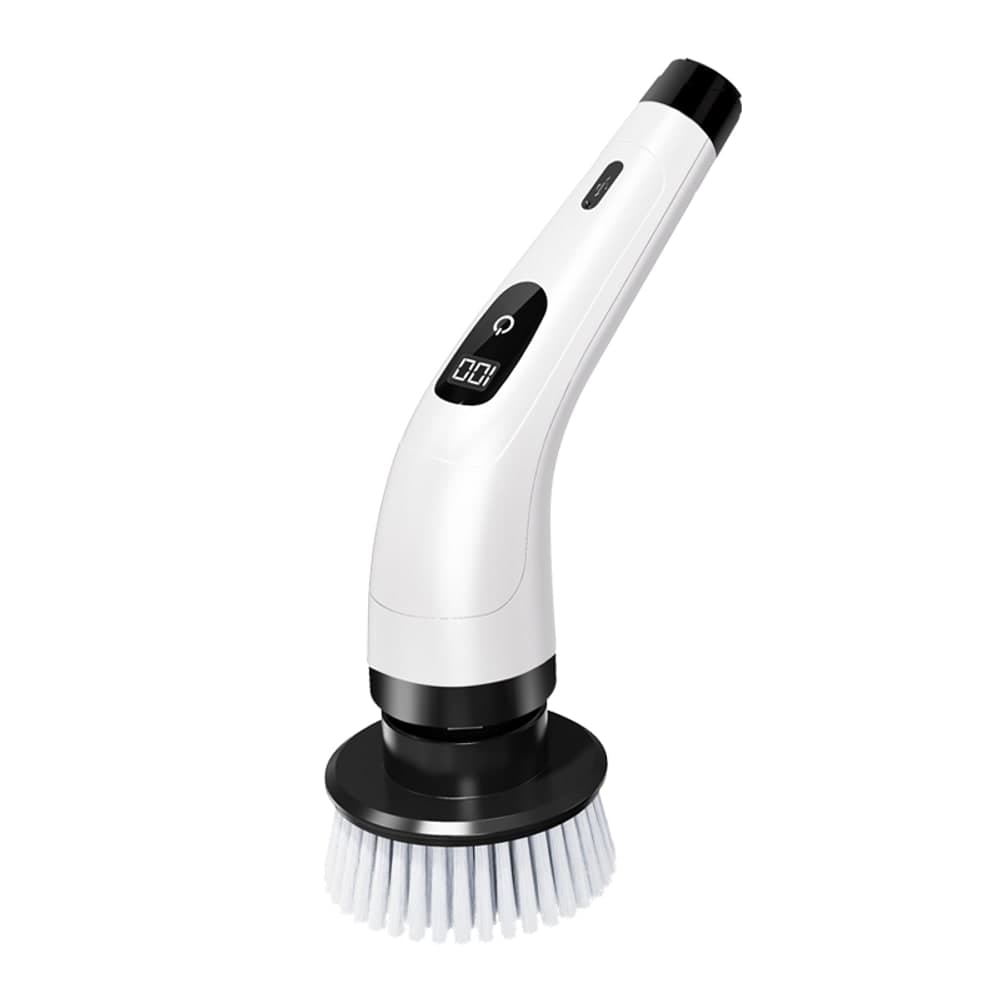
Every cordless electric cleaning brush in our catalogue ships with eight interchangeable heads, and buyers reading a quotation often assume those eight are the same across the range. They are not: the three models we list share seven heads and differ on the eighth, the waterproof rating moves from IPX5 to IPX7, and the published weight per unit runs from 1.04 kg to 1.34 kg. This guide maps each head to a surface and shows how to write the combination into an order.
Three models, three head sets
These are the head lists exactly as they are published on our product pages.
- QX-018 — listed at USD 8.38, MOQ 50 pcs: large flat brush, small flat brush, polishing brush, pointed brush, sponge brush, scouring pad, cloth brush (for leather), fiber brush.
- QX-019 — listed at USD 9.39, MOQ 50 pcs: large flat brush, small flat brush, shower head brush, pointed brush, sponge brush, scouring pad, cloth brush (for leather), fiber brush.
- QX-020 — listed at USD 10.20, MOQ 50 pcs: large flat brush, small flat brush, puff brush, pointed brush, sponge brush, scouring pad, cloth brush (for leather), fiber brush.
Seven heads are common to all three models: large flat, small flat, pointed, sponge, scouring pad, cloth brush for leather, and fiber. The eighth head is model-specific — a polishing brush on the QX-018, a shower head brush on the QX-019, a puff brush on the QX-020.
That single difference is where order errors start: a buyer picks the long-handle model, assumes the accessory set is identical apart from the handle, and quotes a range without the head that sells it. If one head is the reason you are choosing a model, name it on the order.
Matching a head to a surface
Treat this as a starting map, and test on a hidden corner before committing a container to one use case.
- Large flat brush — open flat surfaces: floor tiles, wall tiles, bathtub sides, large panels.
- Small flat brush — narrow flat surfaces and edges: ledges, small countertops, the flat face of a fitting.
- Pointed brush — the geometry a flat head cannot reach: grout lines, corners, the base of a tap, seams and gaps.
- Sponge brush — softer contact for surfaces you do not want to mark: basins, acrylic, coated panels.
- Scouring pad — dried or baked-on residue on hard surfaces, such as stovetops and oven trays.
- Cloth brush (for leather) — the pad supplied for leather and similar soft coverings, including car interiors.
- Fiber brush — textured and coarser surfaces, and outdoor items such as wheels and grilles.
- Polishing brush (QX-018 only) — the finishing step after cleaning, to bring a surface back to an even look.
- Shower head brush (QX-019 only) — curved and pierced fittings: shower heads, spray arms, perforated panels.
- Puff brush (QX-020 only) — the gentlest contact, for delicate items and light dusting.
Two practical notes. Rotation speed does not change with the head: all three models run 320 RPM for daily cleaning and 370 RPM for quick stain removal, so the head is your main control over how aggressive a pass is. And heads are consumables — if you are running a retail programme, order spare heads.
What else changes between the three models
- Battery: 2000 mAh on the QX-018, 4000 mAh on the QX-019, 2000 mAh on the QX-020.
- Runtime: about 50 minutes on the QX-018, about 120 minutes on the QX-019, about 50 minutes on the QX-020.
- Water resistance: IPX5 (QX-018), IPX7 (QX-019), IPX6 (QX-020).
- Handle: the QX-019 has a long handle with a detachable stainless steel extension rod for floors, high tiles and under-furniture work; the QX-018 and QX-020 are handheld.
- Colours: white, green and pink on the QX-018; white on the QX-019; white on the QX-020.
- Shared platform: 3.7 V, copper-core motor with maximum power 75 W, 360° rotation, two speeds (320 / 370 RPM), LED battery display, Type-C charging at DC 5.0 V, main unit approximately 293 g, ABS housing.
- Listed price and MOQ: USD 8.38 (QX-018), USD 9.39 (QX-019), USD 10.20 (QX-020); MOQ 50 pcs each, quoted FOB Yiwu.
If the retail price point matters more than runtime, the QX-018 is the cheaper entry. If the use case is floors and high walls without bending, the runtime and IPX7 rating of the QX-019 are what the extra dollar buys. Settle that before the head list is fixed.
How to write a head combination into an order
A head combination is a configuration instruction. If it is not written down, the factory packs the standard set. Use this six-line format in your purchase order.
- Model and quantity — for example, QX-019, 200 pcs.
- Head list — name all eight heads, copied from the product page, so there is no room for interpretation. Write "standard eight" only if the standard set is what you want.
- Colour — state one, or the split by quantity if you are ordering several.
- LOGO — whether your own branding is applied, and where.
- Packaging — retail box, colour box or export carton, and whether you need local-language material inside.
- Carton and lead time confirmation — ask us to confirm units per carton, carton dimensions and weight against your order, and to state the lead time in writing.
Brush head combinations, colours, LOGO and packaging are all stated as customizable on these three models, so points 2 to 5 are configuration choices. Say what you need at quotation stage: a head list changed after the carton is printed is a cost you carry.
Carton maths for a trial order
MOQ is 50 pcs per model, and the packing data on the product pages is enough to size a trial order before you request a quotation. The arithmetic:
- CBM per carton = (L × W × H in cm) ÷ 1,000,000
- Cartons for your order = order quantity ÷ units per carton
- Indicative shipment weight = order quantity × published weight per unit
Worked on the QX-018 (10 pcs per carton, carton 48.5 × 37.5 × 42 cm, 1.04 kg per unit):
- CBM per carton: 48.5 × 37.5 × 42 ÷ 1,000,000 = 0.0764 CBM
- 50 pcs = 5 cartons ≈ 0.382 CBM
- Indicative weight of 50 pcs: 50 × 1.04 = 52 kg, before the carton itself is added
The QX-019 packs 10 pcs per carton in a 44.5 × 44.5 × 38.5 cm carton at 1.34 kg per unit: 0.0762 CBM per carton, 5 cartons ≈ 0.381 CBM for a 50 pcs order, and an indicative 67 kg before the carton itself is added.
The two cartons are almost the same volume, but the QX-019 weighs roughly 15 kg more per 50 pieces because the unit itself is heavier. On sea freight that is noise; on air freight it is the number that decides your margin. These are published per-unit figures, not a gross weight per carton — confirm packing per order.
One gap we will not estimate: the QX-020 carries no published carton figure — its listing states colour box packaging with packing confirmed per order. We will confirm the carton for your quantity in writing.
Five checks before you confirm a brush order
- Does the order's head list match the head list on the product page you quoted from?
- If you are buying more than one model, is there a separate head list for each, rather than an assumption that the sets match?
- Is the colour split stated per quantity, not just as a set of options?
- Have you asked for carton size and unit weight confirmed against your order quantity?
- Have you recorded the lead time in writing — 3–7 days for in-stock items, 15 days for standard production, 25–40 days for full customization, with samples in about 7 days?
What we publish, and what we leave blank
Every figure above comes from our own product pages:
- Electric Cleaning Brush QX-018 Multi-functional Bathroom Kitchen Cleaning Brush
- Electric Cleaning Brush QX-019 Long-Handle High-Power Cleaning Brush
- Electric Cleaning Brush QX-020 Portable Multi-Function Cleaning Brush
For the wider category view — price bands, OEM options and shipping notes — read our wholesale buying guide for electric cleaning brushes. For the packing numbers behind the carton maths above, see what "standard export carton" doesn't tell you.
We do not publish numbers we cannot verify, so you will not find a charging time, a motor service life, a production capacity figure or after-sales terms on these pages. Certification documents (CE / RoHS) are available on request, and lithium battery shipments may require test documentation for your lane — tell us the destination and we will confirm what can be provided on request.